The SX ultrafine mill
full specs & working principle
A three-/four-ring medium-speed mill — the heart of every powder line. Below are the full parameters, the running principle and the grindable materials for all four standard models. Hand them to an engineer and we can work an entire line back from them.
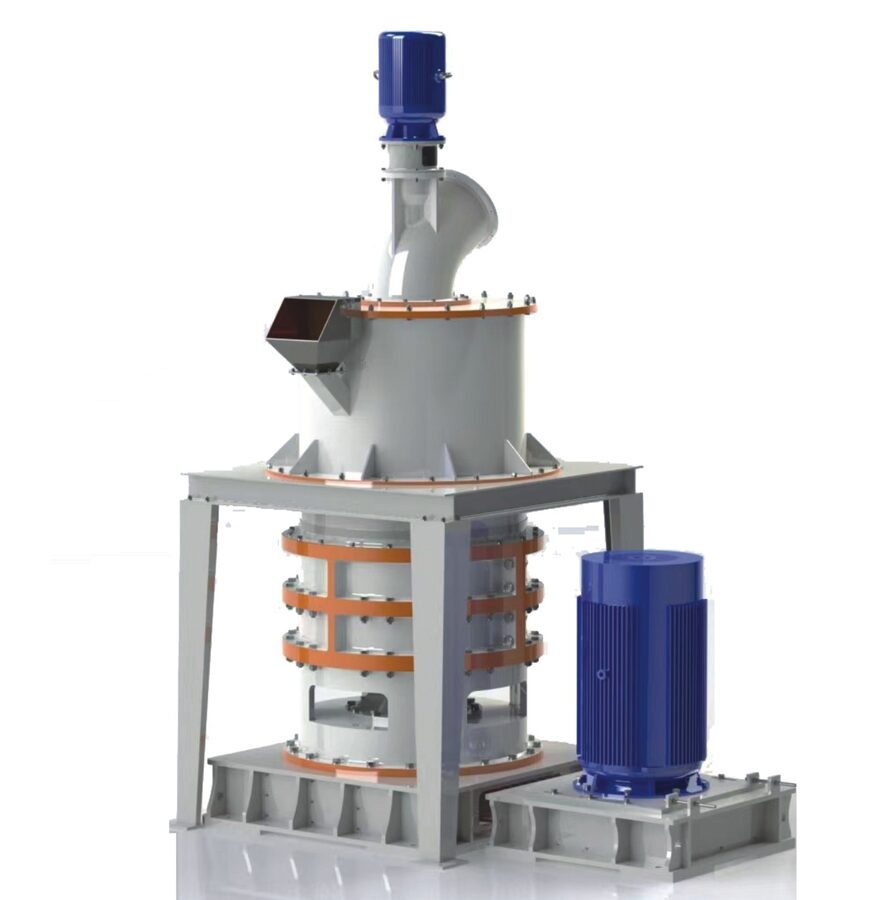
One machine grinds 100+ brittle minerals, from filler to ultrafine
The SX series handles brittle minerals up to Mohs hardness 6 — calcite, limestone, dolomite, barite, talc, gypsum, kaolin and more. Ring-and-roller grinding, high-efficiency classifying and negative-pressure collection keep the whole machine producing steadily inside a sealed loop.
- Fineness 325–3250 mesh — one unit covers coarse to ultrafine, no swapping between machines.
- Finished D97 ≤ 5 µm achievable, meeting ultrafine filler requirements.
- Sealed negative-pressure running — less dust and spillage on the workshop floor.
- Variable-frequency drive — output and fineness tuned on demand, with controllable running costs.
What sets it apart — point by point
Low investment cost
At the same fineness, lower investment and cost than a jet mill, with a shorter payback cycle.
Low wear-part loss
Roller and ring are made of high-quality wear-resistant materials with a forging process, giving a long service life.
Safe and reliable operation in the grinding cavity
No rolling bearings and no screws inside the grinding cavity, avoiding the loose-screw damage common to traditional mills.
More stable transmission
A reducer transmission device is more stable and more efficient than a traditional belt drive.
Accurate particle size control
A new high-efficiency cage powder separator with variable-frequency control gives easy fineness adjustment and precise cutting size; one-pass finished fineness can reach D97 = 5 µm.
Environmental protection
A high-efficiency pulse dust collector gives high collection efficiency with no dust spillage; a silencer and soundproof room greatly reduce noise, meeting the latest national environmental standards.
Four standard models — pick by capacity
| Model | Working Ø (mm) | Max input (mm) | Speed (r/min) | Capacity (kg/h) | Rollers (pcs) | Ring layers (pcs) | Output size (mesh) |
|---|---|---|---|---|---|---|---|
| SX-80 | 800 | 10 | 230–240 | 500–5000 | 21 | 3 | 325–3250 |
| SX-100 | 1000 | 10 | 180–200 | 1000–8500 | 28 | 4 | 325–3250 |
| SX-125 | 1250 | 15 | 135–155 | 1500–11200 | 32 | 4 | 325–3250 |
| SX-168 | 1680 | 20 | 120–130 | 5000–25000 | 36 | 4 | 325–3250 |
Finished 325–3250 mesh · D97 ≤ 5 µm achievable · four standard models (SX-80 / 100 / 125 / 168). Capacity and fineness depend on material, moisture and target — subject to engineer assessment.
A complete line — matched mill to collector
| Auxiliary equipment | Model | Power (kW) |
|---|---|---|
| Main mill motor | — | 75 / 132 / 185 / 315 |
| Separator variable-frequency motor | — | 18.5 / 30 / 75 / 132 |
| Blower motor | — | 45 / 75 / 132 / 200 |
| Hammer crusher | SXH-400×600 | 18.5 / 18.5 / 45 / 45 |
| Belt conveyor feeder | SXF-300×60×1.8 | 1.5 |
| Bucket elevator | SXE-200×9.79 | 3 / 3 / 5.5 / 7.5 |
| Screw conveyor | SXSC-219×4.5 | 3 / 4 / 7.5 / 7.5×2 |
| Discharge valve | SXD-200-2 | 0.75×2 / 1.1 / 1.5 / 1.5×2 |
| Pulse dust collector air compressor | SXP-2.8/8 | 15 / 30 / 37 / 55 |
Auxiliary equipment scales with the main mill model (SX-80 / 100 / 125 / 168); values shown cover the four standard models in order. Models are neutral StoneX codes — actual selections are subject to engineer assessment.
Material in, finished powder out — a fully sealed loop
Feeding
Crushed material is lifted into the storage hopper and metered into the mill by a vibrating feeder; the feed rate tracks output automatically.
Ring & roller grinding
Material drops between the grinding ring and rollers. The main spindle spins the rollers at speed and centrifugal force presses them home, crushing the feed into powder.
High-efficiency classifying
Rising airflow carries the powder up to the classifier; on-spec fines pass through while coarse particles fall back for regrinding. Fineness is set by classifier speed.
Cyclone collection
Finished powder travels with the airflow into the cyclone collector, where it separates out and drops to the discharge below as product.
Pulse dust removal
Exhaust air is cleaned by a pulse bag dust collector before it leaves the system; the recovered micro-powder is counted back into the finished product.
Packing
Product is conveyed under sealed transfer to a dosing packer for precise metering — bagged, weighed and ready to ship straight from the line.
Brittle minerals up to Mohs hardness 6 — 100+ kinds
Material list is a demonstration placeholder. Hardness, moisture and target fineness are subject to engineer assessment.
The SX mill on the plant floor
Representative / illustrative installation renders — click any image to enlarge. Shown to convey typical layout and scale, not photographs of a specific customer site.
Send your material and target fineness — we'll match the right mill.
Engineers review every enquiry line by line and return an initial model pick and whole-line proposal within one working day — and you can run a feed-material trial before you buy, deciding once you've seen the powder.